Software Nerd

Tuesday, May 06, 2008

"Nature"... illustrated for children


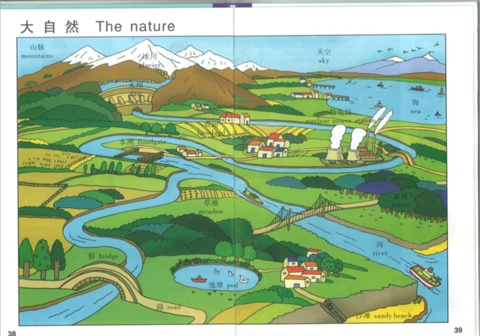
A Chinese children's book has this illustration, titled "Nature".

Does it look like a reasonable depiction of nature for a child's book? It does to me.

To my surprise, someone thought this was oddly funny, and submitted it to the Boing-Boing site as humor.

Turns out that nature being depicted as something humans use is seen as oddly funny. Well, not by the Chinese, it would appear!

Labels:

Wednesday, September 26, 2007

An "ObjectivistKid" encounters religion

... Around kindergarten was the first time Z mentioned God. I think he suddenly made some type of matter-of-fact comment that God was listening to us, because He is everywhere...
Read more here.

Labels:

Saturday, June 23, 2007

Theories of Childhood

Thanks to Brad for recommending "Theories of Childhood: An Introduction to Dewey, Montessori, Erikson, Piaget, & Vygotsky" by Carol Garhart Mooney. This 100-page book is an extremely brief summary of five theorists on childhood.

The comments on Dewey were interesting, because the author claims that some of the extreme progressive ideas are misinterpretations, and not what he meant. It raises the issue of reading originals versus trusting secondary sources. The author does not try to defend the authenticity of her interpretation, that's not the focus of the book. Instead, she simply states her interpretation and runs with it.

The author paints a positive picture of Dewey, as a reactionary against traditional, rote learning, calling for a focus on the child's interests and on making learning fun. She claims that Dewey did not say that kids should be allowed to do anything that was fun. Rather, she says, he encouraged specific teaching goals, but wanted them to be taught in a way that interests the child. She gives an example of painting class, where progressive teachers will leave children to their own "creativity", allowing and even encouraging them to do whatever they feel like: paint any objects, in any shapes, any colors, without any purpose except "expressing" themselves. Mooney claims this is a misinterpretation of Dewey, and that he never intended lessons to lack a pedagogical end.

Was that really what Dewey wanted? It's impossible to know, unless one reads more. Was he really rasing valid objections to the established ways without offering new methods, thus leading to him being misinterpreted as wanting to throw out the good with the bad? Or, is Mooney putting lipstick on a pig? Of course it is not enough to say traditional teaching is bad, it is also insufficient to say that one must use the child's interests, but still achieve pedagogical goals; that begs the question: what are those goals.

It's telling that Mooney does not mention any such positives in her summary of Dewey; but then, this book is a very condensed summary, by design.

Overall, it was fairly informative.

Labels:

Friday, March 04, 2005

Look-say

"Look-say" is a good term to describe the way kids should learn many concepts. Point at a table (not the word "table") and tell the kid it is a table. Concepts of consciousness are also learned this way. In response to a child remembering something, you comment "oh, you remember that!" Implicitly, you are "pointing" to the mental process the child just underwent and telling him it is "remembering". As with the table, you isolate a particular element of reality and name it.

Unfortunately, the term is "taken". "Look-say" describes a faulty way of teaching children to read. A child may learn a particular word by looking at the word. Teaching phonetically means teaching the kid to read any word.

For more on phonetic/look-say in reading, see...Why Johnny Can't Read

Labels:

Saturday, February 26, 2005

Computers in Elementary School

Should elementary kids learn computers? Some say that computers cannot help and might even be distracting, at best. Others say that in this age of computers we need to start our kids off early.

Its fine for elementary kids to learn how to use a computer for something other than games, but its far-fetched to suggest that it will help them use computers later. Using the typical tools -- word-processors & spreadsheets -- takes very little training.

On the other hand, I'm not a complete Luddite about this either. I think that some well-constructed teaching programs can be useful. They are particularly useful in drill. There are many things that a child learns by mental drill -- repetition.

Here's one example from the life of my 6 year old. He's learning certain "math facts". Having past the stage of being able to add number by counting, he is now being taught to memorize some. Presented with any pair of single digit numbers, he should be able to recall their sum, difference and product, without having to mentally add, subtract or multiply them.

He was stuck on the memorizing the products. His "7 times tables" were hard, and so were 8 and 12. Every day, I would quiz him on two or three pairs. In a spare moment, I might ask: "So, what is 7 times 8". After about a week, I found that he was able to remember more. So, I wrote a small software program to:
  • display a "problem", like " 7 x 8 = ??";
  • accept an answer; and,
  • say if it was right or wrong.


It also displayed a score at the top of the screen, "You got 5 right out of 6". I randomized the selection of numbers that would be presented. I also made it log each question and whether it was answered right -- that way I could review it and see if he was having trouble with certain specific pairs (why is "7 times 8" so hard?).

It worked! He has been able to drill at odd moments, and without my being there to help him. The drill has improved his retention of the "Math facts". He even finds the process mildly interesting.

So, yes, a computer can be a useful tool, if applied to the right type of educational problem. Not the computer as something to learn, but the computer as a tool to help teach something else.

Labels: